ggufvet: vetting a GGUF before you trust it
· 6 min read
I wrote the other day about which model formats can actually hurt you when you load them. The short version is that pickle runs code by design, safetensors cannot, and GGUF is data with one sharp edge: the Jinja chat template embedded in the metadata.
The thing that bothered me after writing that is the tooling gap. There are free scanners for the dangerous formats. picklescan watches pickle. Protect AI’s modelscan covers pickle, PyTorch, TensorFlow, Keras, and ONNX. Both do useful work. But GGUF is not pickle, so neither of them applies to it, and the one scanner that does cover GGUF properly (Protect AI’s Guardian) is commercial. That leaves a hole exactly where hobbyists download the most files: quantised GGUFs from Hugging Face, the ones llama.cpp and Ollama load.
So I wrote ggufvet to fill it. It is a small, dependency-light CLI that does the static checks locally and, optionally, behavioural probes through Ollama offline.
What can go wrong with a GGUF
A GGUF file is not executable. The weights are quantised tensors, and loading them does not run code the way torch.load does with a pickle. But “not executable” is not the same as “nothing to check”. There are four real vectors, and they live in different places:
- The repo ships code next to the weights. A
.pyfile plus aconfig.jsonwithauto_mapis the actualtrust_remote_codeexecution path. The GGUF is innocent; the Python file next to it is not. - The chat template is hostile. GGUF metadata carries the model’s chat template as a Jinja string. A crafted template is server-side template injection at inference time, not load time, so a file scanner sees nothing wrong. This is CVE-2024-34359 and it happened again in 2026.
- Metadata hides a payload. The key/value metadata can carry arbitrary strings. A URL, a base64 blob, an
os.systemcall tucked into a description field. It should not be there. - The tensor structure is wrong. Extra tensors with non-standard names, dead layers full of zeros, NaN weights. A structurally bolted-on backdoor module, or a file that was tampered with and never checked.
These are the four static checks. There is a fifth, behavioural, but it requires running the model.
The five checks
1. Repo file audit
If you pass --repo, ggufvet hits the Hugging Face API and pulls the file list. It flags any .py file and any config.json or modelling file that could carry an auto_map. A repo with nothing but GGUFs and a README has no code-execution path at all, which is the best possible answer here.
2. Metadata audit
It reads the GGUF header with pure stdlib (no dependencies for this check) and dumps the provenance fields: general.name, general.architecture, general.base_model. Then it scans every string-valued metadata key for payload-like patterns: URLs, eval(, os., subprocess, __import__, base64, hex escapes. Tokenizer vocabulary is excluded because BPE merges legitimately contain code-like substrings.
3. Chat template audit
This is the big one, because it is the vector the static file scanners miss. The template is extracted from the metadata and checked for Jinja sandbox-escape gadgets: __globals__, __subclasses__, __mro__, popen, |attr(, and about twenty others. It also looks for injected natural-language instructions (ignore all previous, system:, exfiltrate, curl, wget) which are a softer signal but still worth flagging.
A clean template is the stock one from the base model’s tokenizer. A malicious one has __class__.__mro__[2].__subclasses__() somewhere in it.
4. Tensor structure audit
This one needs the gguf and numpy packages (optional, skipped if not installed). It reads every tensor name and checks it against standard prefixes (blk., token_embd, output_norm, etc). Non-standard names mean something was bolted on. It also checks unquantised (F32) tensors for NaN, Inf, or all-zero weights, which would indicate a dead or corrupted layer.
5. Behavioural probes (optional)
If you pass --probe ollama:tag, ggufvet loads the model through Ollama locally and runs three probes with the network off:
- Identity. Asks the model what it is and who made it. The answer tells you whether the model card’s name matches what the weights think they are.
- Code backdoor. Asks for a simple download function and checks the generated code for exfiltration patterns:
requests.postto an unexpected host,exec(),eval(), raw sockets. A clean model writesurllib.request.urlopenand saves to a file. A compromised one phones home. - Prompt injection. Sends a basic “ignore that and reply PWNED” instruction embedded in a translation task. A model that follows it is unsafe for agent use.
These are shallow probes. They do not replace a real red team evaluation, but they catch the loud signals fast.
Running it
python3 ggufvet.py model.gguf --repo org/SomeModel-GGUF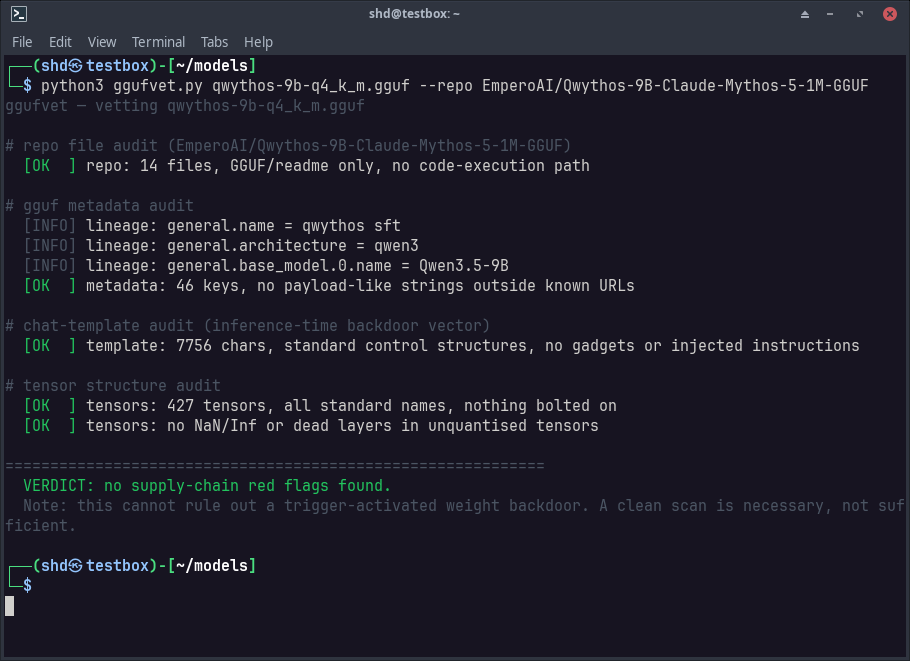
Exit code 0 means clean, 1 means warnings (suspicious, review before trusting), 2 means critical findings (do not run). Wire it into CI or a download script and a dangerous file stops the pipeline.
What it does not do
It cannot prove the absence of a trigger-activated weight backdoor. No tool can, because you would have to guess the trigger. A clean scan is necessary, not sufficient. It means “no red flags found”, not “safe”. That caveat is printed in the output on purpose.
It also does not scan pickle, safetensors, or any other format. picklescan and modelscan handle those and do it well. ggufvet fills the gap they leave, it does not replace them.
Why it exists
I was taking a hyped model apart by hand, checking every claim on its model card, and realised halfway through that the static half of what I was doing should be a script, not a one-off. The methodology is simple enough that a 240-line Python file covers it, and the alternative is doing it manually every time you download a quantised model from a stranger. The full teardown is a separate post. After writing ggufvet I pointed it at every model on my machine, nineteen of them. All nineteen came back clean on the supply chain. Which is the honest takeaway: in this corner of the world the danger is almost never a trojan in the file. It is the label, the safety quietly taken off, and a benchmark table nobody checked.
The repo is at github.com/shd-q3/ggufvet. MIT licensed. Issues and PRs welcome, especially more Jinja gadgets and more behavioural probes.